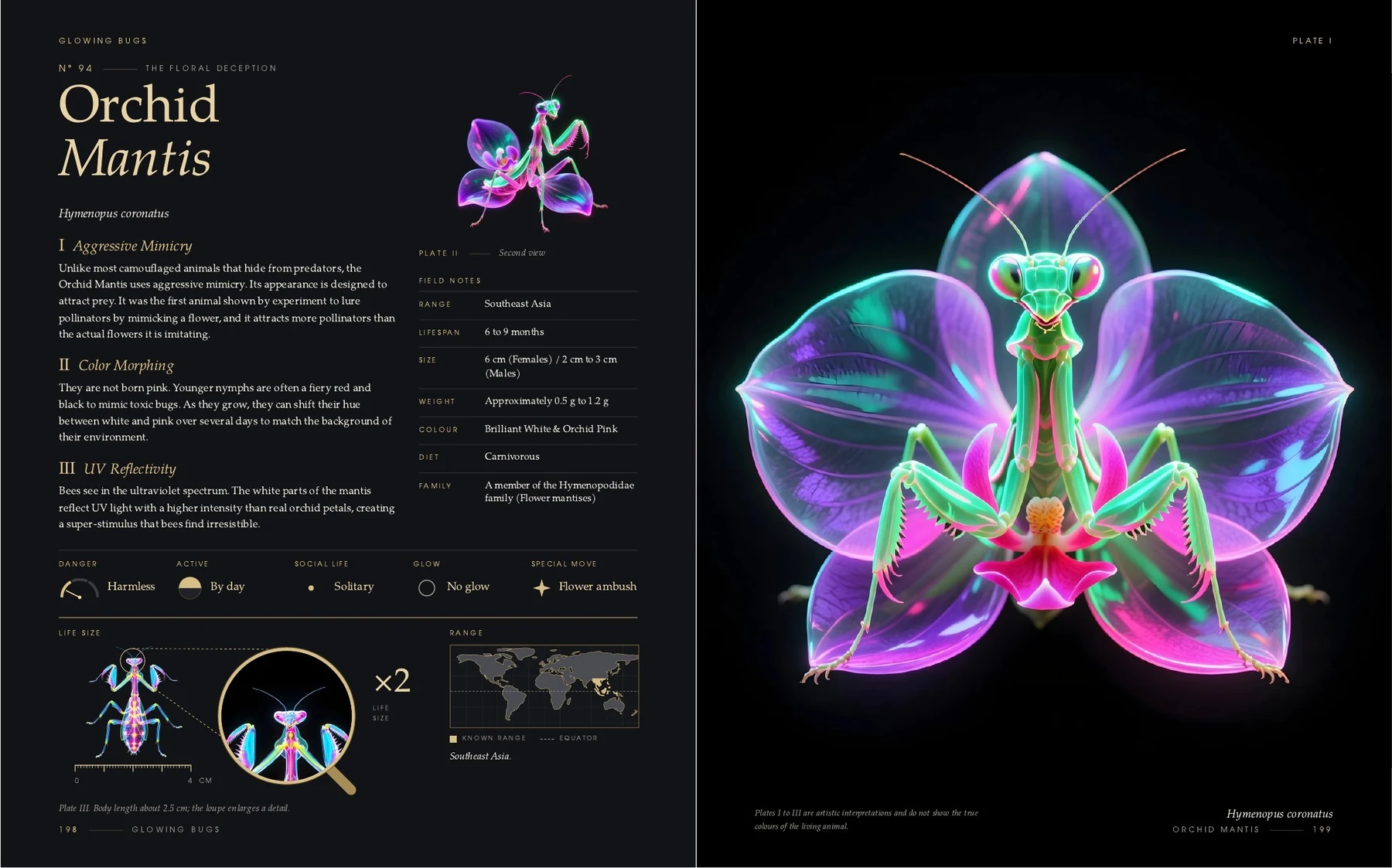
Orchid Mantis
Hymenopus coronatus
Aggressive Mimicry
Unlike most camouflaged animals that hide from predators, the Orchid Mantis uses aggressive mimicry. Its appearance is designed to attract prey. It was the first animal shown by experiment to lure pollinators by mimicking a flower, and it attracts more pollinators than the actual flowers it is imitating.
Color Morphing
They are not born pink. Younger nymphs are often a fiery red and black to mimic toxic bugs. As they grow, they can shift their hue between white and pink over several days to match the background of their environment.
UV Reflectivity
Bees see in the ultraviolet spectrum. The white parts of the mantis reflect UV light with a higher intensity than real orchid petals, creating a super-stimulus that bees find irresistible.
Field notes
| Range | Southeast Asia |
|---|---|
| Lifespan | 6 to 9 months |
| Size | 6 cm (Females) / 2 cm to 3 cm (Males) |
| Weight | Approximately 0.5 g to 1.2 g |
| Colour | Brilliant White & Orchid Pink |
| Diet | Carnivorous |
| Family | A member of the Hymenopodidae family (Flower mantises) |
In the book
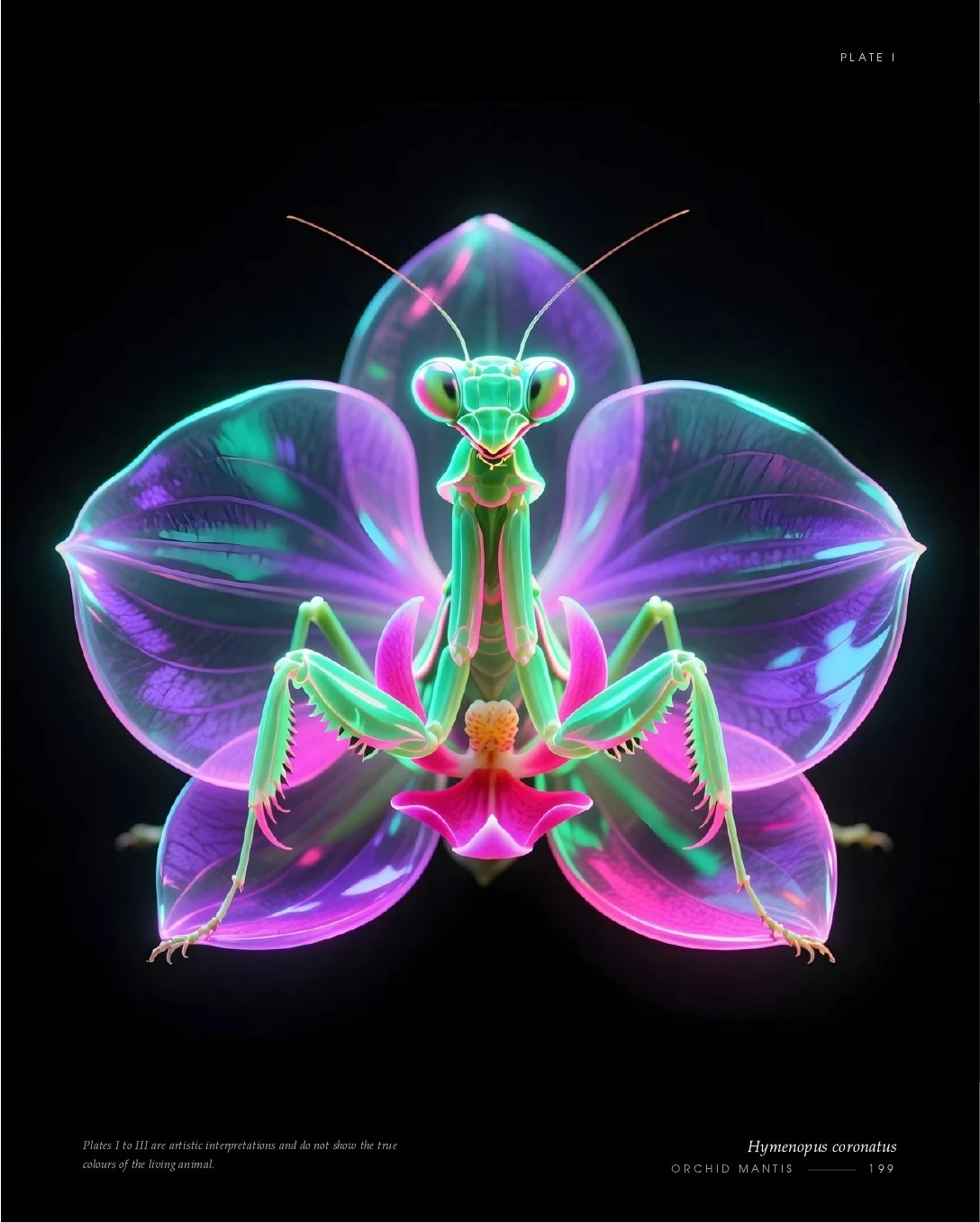
The Orchid Mantis is number 94 of the 101 creatures in Glowing Bugs. Its two pages show it from three sides, at its true size, with a map of where it lives. The plate is an artistic interpretation and does not show the true colours of the living animal.