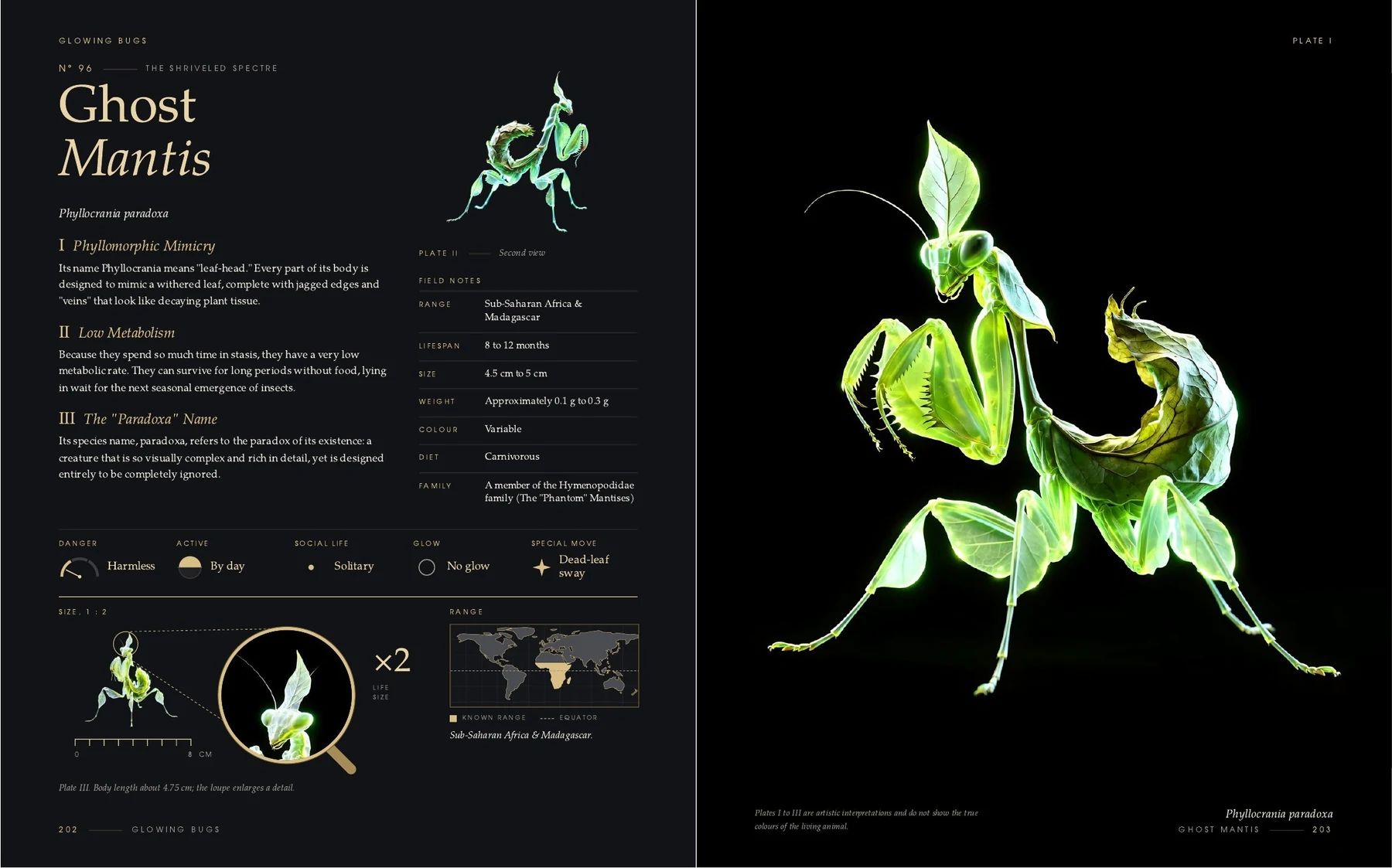
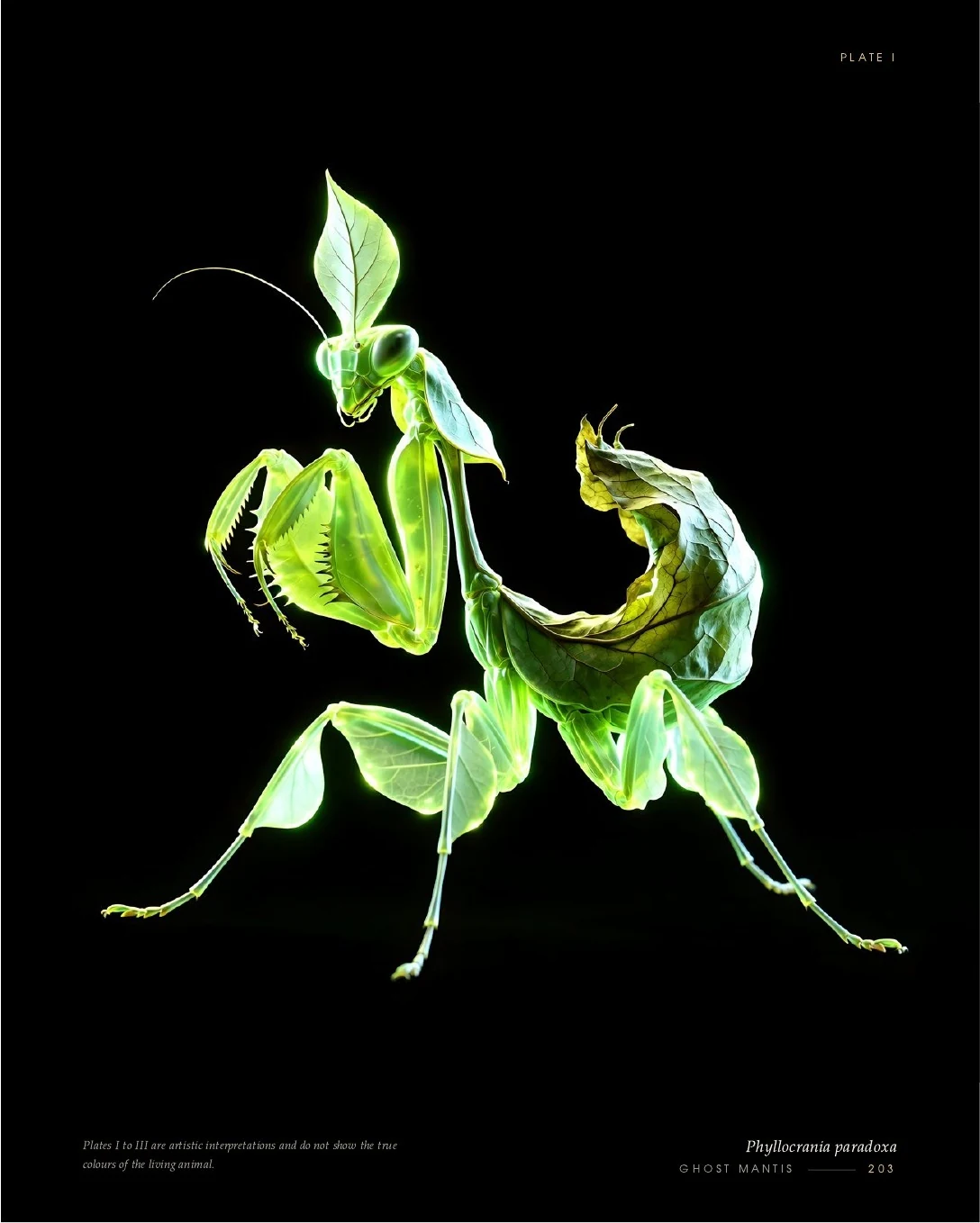
Ghost Mantis
Phyllocrania paradoxa
Phyllomorphic Mimicry
Its name Phyllocrania means "leaf-head." Every part of its body is designed to mimic a withered leaf, complete with jagged edges and "veins" that look like decaying plant tissue.
Low Metabolism
Because they spend so much time in stasis, they have a very low metabolic rate. They can survive for long periods without food, lying in wait for the next seasonal emergence of insects.
The "Paradoxa" Name
Its species name, paradoxa, refers to the paradox of its existence: a creature that is so visually complex and rich in detail, yet is designed entirely to be completely ignored.
Field notes
| Range | Sub-Saharan Africa & Madagascar |
|---|---|
| Lifespan | 8 to 12 months |
| Size | 4.5 cm to 5 cm |
| Weight | Approximately 0.1 g to 0.3 g |
| Colour | Variable |
| Diet | Carnivorous |
| Family | A member of the Hymenopodidae family (The "Phantom" Mantises) |
In the book
The Ghost Mantis is number 96 of the 101 creatures in Glowing Bugs. Its two pages show it from three sides, at its true size, with a map of where it lives. The plate is an artistic interpretation and does not show the true colours of the living animal.